What hericenones, erinacines, cultivation methods, and β-glucans can tell you about quality.
Lion’s Mane (Hericium erinaceus) is one of the most talked-about functional mushrooms in the world. But, not all Lion’s Mane supplements are created equal.
One of the biggest differences comes down to which part of the fungus is used (fruiting body vs mycelium), how it is cultivated, and what is actually measured on the label.
This guide explains the key differences in plain English, including why people care about hericenones and erinacines, what “Di Dao” implies for sourcing, and how β-glucans can be a practical quality signal when other compounds aren’t disclosed.
👉 Learn about Lion’s Mane: Benefits, Uses & Dosage
👉 Learn why Mycobio Lion’s Mane is different
1. Fruiting Bodies vs Mycelium (Simple Definitions)
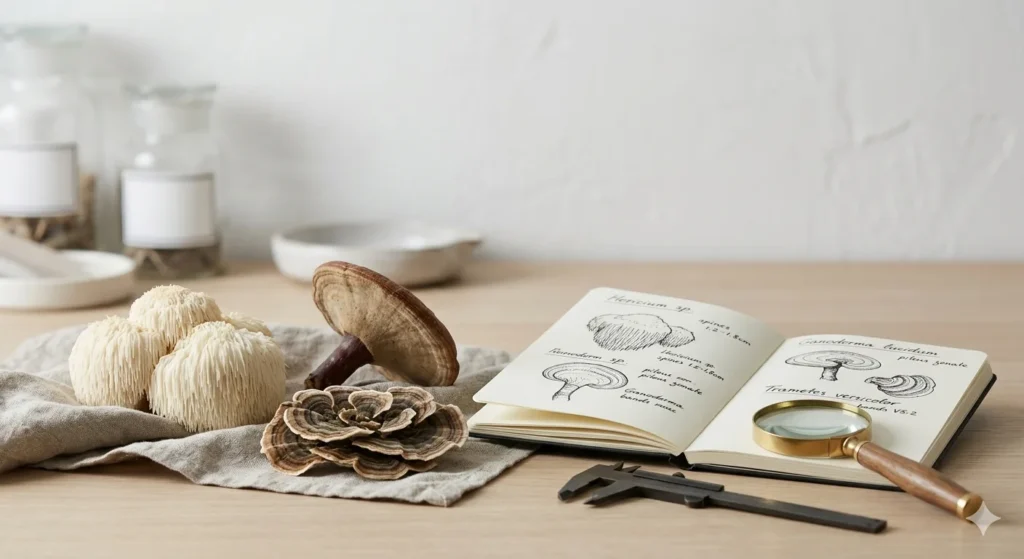
- Fruiting body is the visible “mushroom” — the part most people recognise as Lion’s Mane.
- Mycelium is the root-like network that grows through a substrate (such as wood, or sometimes grain) and supports the organism’s growth.
Both are part of the same organism, but they are different tissues and can express different chemistry depending on growth conditions and processing.1
2. Why Lion’s Mane Is Unique
Lion’s Mane stands out because it contains compound families studied for their potential involvement in nerve growth factor (NGF)-related pathways and neuroprotective mechanisms (much of this evidence is preclinical and depends heavily on preparation and dose).2
Hericenones
Hericenones are most commonly discussed in relation to Lion’s Mane fruiting bodies, and are frequently cited in studies exploring NGF-related activity in experimental models.3
Erinacines
Erinacines are most commonly isolated from Lion’s Mane mycelium, and compounds like erinacine A have been studied for neuroprotective potential in preclinical research (including mechanistic work).4
Key point: “Fruiting body vs mycelium” isn’t a mere marketing preference, it can meaningfully influence which compound families a product is more likely to contain.1
3. How Cultivation Changes What the Fungus Produces
Here’s a detail many brands skip: growing conditions can shape chemistry. Substrate type, environmental stressors, and ecological complexity can influence fungal metabolite expression — meaning “how it was grown” can matter, not just “what it is.”1
Artificial / Indoor Cultivation (Including Liquid Culture)
Modern production often uses controlled indoor systems (including liquid culture for mycelium) to improve consistency and scale. This can reduce contamination risk and make output more predictable.
However, tightly controlled environments may also change the organism’s metabolite profile compared with more complex natural conditions. This does not automatically mean indoor-grown material is inferior — but it highlights why method transparency matters, especially for products marketed around specific bioactives.2
Outdoor Cultivation on Natural Wood (And the “Di Dao” Idea)
“Di Dao” is a traditional quality concept often used in herbal practice to describe materials produced in their optimal geographic and ecological environment — where climate, substrate, and local biodiversity support high-quality development.
Lion’s Mane naturally grows on hardwood trees. Cultivation on natural wood (especially when it better replicates ecological conditions) aligns with the broader scientific idea that substrate and environment can influence fungal metabolite expression.1
Practical takeaway: “Outdoor on natural wood” is not just a romantic story. It can be a meaningful signal that the producer is aiming to replicate conditions under which fungi evolved to express their chemistry.
4. The Mycelium Trade-off: Potential Bioactives vs Dilution Risk
There are two very different “mycelium” realities in the supplement market:
- Mycelium as fungal biomass (e.g., grown and processed so the final material is mostly fungus)
- Mycelium grown on grain and milled together with the substrate (higher risk of starch-heavy dilution)
If a product contains substantial grain substrate, you may be paying for carbohydrate and filler rather than concentrated fungal material. Analytical studies of commercial mushroom supplements have documented how grain-based materials can shift measured carbohydrate profiles and can resemble substrate more than consumers expect when not properly separated.5
5. β-Glucans Explained (And Why Alpha vs Beta Matters)
β-glucans are structural polysaccharides in fungal cell walls and are widely studied in relation to immune signaling and biological response (structure and source matter).67
α-glucans are also carbohydrates. While fungi can contain α-glucans, elevated α-glucans (and starch) are often discussed in the context of detecting substrate carryover in some production styles, particularly grain-associated biomass.8
Consumer-friendly rule of thumb: A supplement claiming “high polysaccharides” without a clear β-glucan figure can be hard to evaluate, because “polysaccharides” may include non-fungal starch and other carbohydrates.5
6. If Hericenones & Erinacines Aren’t Listed, Can β-Glucans Indicate Quality?
This is the most useful practical question — and the answer is nuanced:
No: β-glucans do not directly measure hericenones or erinacines (they are different classes of compounds).
Yes (as a proxy for integrity): β-glucans can still be a strong indicator of overall product quality because higher β-glucans generally suggest a higher proportion of true fungal material and a lower risk of substrate dilution — especially when paired with transparent cultivation and third-party testing.5–8
How to interpret this:
- If a product has clearly reported β-glucans (and ideally also reports α-glucans or starch), it is often a sign the manufacturer is willing to measure what matters.
- That doesn’t guarantee high hericenones/erinacines — but it can mark a product as more likely to be “real mushroom” rather than “mushroom-flavoured carbohydrate.”
7. Which Is Better: Fruiting Body, Mycelium, or a Blend?
Fruiting body extracts often make sense when:
- You want a formulation aligned with much of the fruiting-body hericenone discussion
- You want to minimise dilution risk from grain-associated biomass
- You value simple transparency about the part used
Mycelium products can make sense when:
- The product is clearly fungal biomass (not mostly grain substrate)
- Erinacine-focused manufacturing is supported by credible testing and method disclosure
A blend can be reasonable if:
- It’s formulated intentionally to combine tissue profiles
- It’s supported by transparent analytics (β-glucans at minimum, plus broader testing where possible)
8. How Mycobio Approaches Lion’s Mane Extract Quality
At Mycobio, extract quality starts long before extraction. The guiding principle is simple:
Biology expresses itself most fully when grown in conditions it evolved within.
For Lion’s Mane, that means prioritising producers who cultivate Hericium erinaceus on natural wood substrates in regions known for ecological suitability — an approach aligned with the “Di Dao” idea that geography, climate, and biodiversity matter for material quality.
While modern cultivation systems (including liquid culture) can offer consistency and scale, Mycobio’s preference is to lean into cultivation contexts that better reflect natural growth conditions — because substrate and environment can influence metabolite expression.1
👉 Learn the 7 reasons Mycobio Lion’s Mane is the best in NZ
👉 Learn the 9 things to look for on a mushroom supplement label
Measured, Not Assumed
Rather than relying on vague “polysaccharide” marketing, Mycobio focuses on measurable indicators — including β-glucans — as practical signals of fungal biomass and product integrity, alongside broader verification practices and supplier transparency.
Fruiting Body First (By Design)
Fruiting bodies are prioritised for their compositional density and alignment with much of the published Lion’s Mane discussion — while also reducing the dilution risks sometimes associated with grain-based biomass. The goal is not ideology; it is integrity.
9. Buyer Checklist (Fast, Practical)
- Species: Listed as Hericium erinaceus
- Part used: Fruiting body, mycelium, or a justified blend
- β-glucans: Clearly reported (not only “polysaccharides”)
- Cultivation transparency: Natural wood vs grain-based biomass vs liquid culture
- Testing: Third-party COAs where possible
- Extraction: Method explained (and consistent with the claimed outcome)
10. The Takeaway
Lion’s Mane isn’t just an ingredient — it’s a biologically complex organism. The most meaningful differences in quality usually come down to tissue selection, cultivation ecology, extraction, and measurement.
If hericenones and erinacines aren’t disclosed (which is common), β-glucans can still be one of the most practical indicators of authenticity and integrity — not because they measure neuroactive compounds directly, but because they often signal “real fungal material” rather than diluted carbohydrate.
In other words: don’t just buy Lion’s Mane. Buy Lion’s Mane you can verify.
👉Learn more about Mycobio’s high quality mushroom extracts
👉 Learn the 9 things to look for on a mushroom supplement label
Footnotes
- Qiu Y, et al. Bioactive substances in Hericium erinaceus: fruiting body, mycelium, and culture broth. Food Bioscience, 2024.
- Contato AG, et al. Lion’s Mane Mushroom (Hericium erinaceus). National Institutes of Health (PMC), 2025.
- Wang J, et al. Hericenones from the fruiting bodies of Hericium erinaceus. Journal of Natural Products, 2024.
- Huang HT, et al. Erinacines from Hericium erinaceus mycelium and their neuroprotective mechanisms. Scientific Reports, 2021.
- Windsor C, et al. Comparative analysis of mushroom supplements and substrate dilution. National Institutes of Health (PMC), 2025.
- De Marco Castro E, et al. β-Glucans and immune function: State of the art. Molecular Nutrition & Food Research, 2021.
- Caseiro C, et al. The molecular structure and applications of β-glucans. PubMed Central, 2022.
- U.S. Food and Drug Administration. Scientific considerations on α-glucan testing for detecting grain residue in fungal materials.